
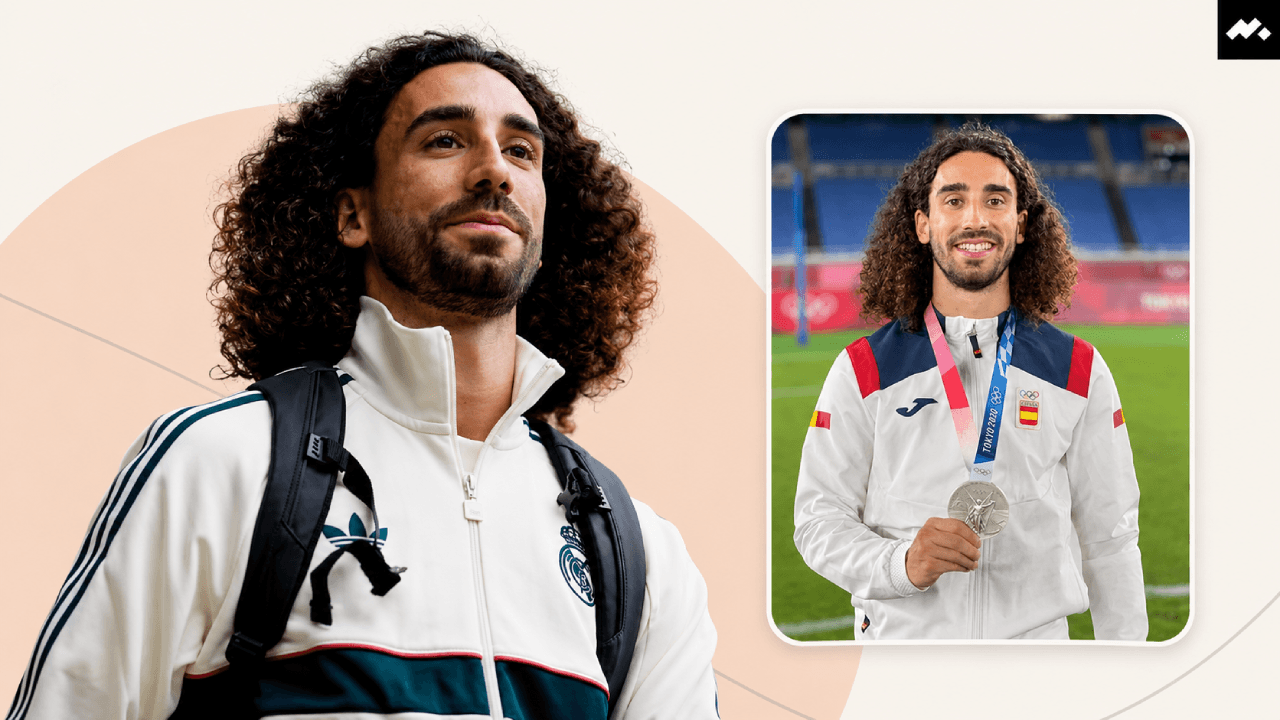
Marc Cucurella is a Spanish left-back who plays for Real Madrid and the Spain national team. After four eventful seasons at Chelsea, he signed a six-year Madrid contract in June 2026 before helping Spain win the World Cup. His move completes an extraordinary change in status: the defender once dismissed as an expensive Chelsea mistake now arrives at the Bernabéu as a world and European champion.
Cucurella’s career has rarely followed the obvious route. He developed at Barcelona but established himself elsewhere, became a Premier League success at Brighton, struggled under the weight of Chelsea’s instability and then rebuilt his reputation through tactical intelligence and relentless work.
Behind that public transformation is a close family unit. His long-term partner, Claudia Rodríguez, and their three children have experienced each transfer alongside him, while the couple have spoken with unusual openness about parenting their autistic eldest son, Mateo.
Who is Marc Cucurella?
Marc Cucurella Saseta was born on 22 July 1998 in Alella, a town in Catalonia near Barcelona. He plays primarily as a left-back but can also operate as a wing-back, a left-sided central defender or an auxiliary midfielder.
His appearance makes him instantly recognisable. The mass of long curls has inspired chants, memes and advertising campaigns, yet the visual identity sometimes distracts from the sophistication of his football.
Cucurella is not a conventional full-back who simply runs along the touchline and crosses. He presses aggressively, moves into midfield during possession and exchanges positions with attacking players. That adaptability has allowed him to succeed in several contrasting systems.
His senior career has taken him through:
- Barcelona B and a brief involvement with the first team;
- loan spells at Eibar and Getafe;
- a permanent move to Getafe;
- Brighton & Hove Albion;
- Chelsea;
- Real Madrid.
Each stage required a different version of the same player. At Getafe, he was shaped by intense, confrontational football. Brighton developed his confidence in possession, while Chelsea eventually turned his positional flexibility into a major strength.
Why Marc Cucurella joined Real Madrid
Real Madrid and Chelsea confirmed Cucurella’s permanent transfer on 15 June 2026. The clubs did not disclose the financial terms, although Reuters reported that British media estimated the agreement could be worth up to £51.8 million.
The official Real Madrid announcement confirmed that his contract runs until 30 June 2032. He was formally welcomed at the Ciudad Real Madrid training complex on 24 August and received the number 17 shirt.
His arrival was delayed because of Spain’s extended World Cup campaign. After returning to club football, he completed his first Madrid training session on 10 August and spoke about the opportunity as a reward for the work behind his unconventional career.
Madrid were not signing an emerging prospect. They were acquiring a 28-year-old with Premier League experience, four major trophies and the tactical range to fill several roles.
Cucurella can provide width when Madrid’s left-sided attacker moves infield, but he is equally comfortable stepping into midfield. That flexibility may be particularly valuable under José Mourinho, whose teams traditionally require defenders to understand when to attack and when to protect the structure behind the ball.
The World Cup triumph that preceded his arrival
Cucurella agreed to join Madrid before the 2026 World Cup, but his performances at the tournament strengthened his standing considerably.
Spain defeated defending champions Argentina 1–0 in the final at New York/New Jersey Stadium on 19 July. Cucurella played every available minute of the competition and provided two assists as Spain kept seven clean sheets.
FIFA’s tournament statistics recorded that Cucurella and centre-back Pau Cubarsí each completed 750 minutes, the joint-highest total among outfield players. He was subsequently included in the supporter-selected World Cup Best XI.
His performance was the continuation of an international rise that began at Euro 2024. Cucurella started six of Spain’s seven matches during that tournament and supplied the cross from which Mikel Oyarzabal scored the late winner against England in the final.
Spain’s structure allowed him to display his most valuable quality: coordinated movement. Alongside a direct winger such as Nico Williams, he could overlap towards the touchline, move inside or remain deeper depending on where space appeared.
The partnership made both players harder to mark. Cucurella’s contribution was not built around spectacular individual skills but around repeatedly making the correct supporting run.
Why his Chelsea transfer became so controversial
Chelsea signed Cucurella from Brighton in August 2022. Brighton described the sale as a club-record transfer, while the widely reported package was worth an initial £56 million and potentially £63 million with add-ons.
The fee altered expectations immediately. Cucurella was no longer judged as a versatile defender adapting to a new club; he was judged against the price of the transfer.
His arrival also coincided with one of the most unsettled periods in Chelsea’s recent history. The club changed managers, recruited a large number of players and repeatedly altered its tactical approach. Cucurella appeared at full-back, wing-back and centre-back without being given a consistent role.
His aggressive defending made mistakes highly visible. He often moved forward to intercept passes or pressure an opponent, but when the press around him was poorly coordinated, the space he vacated became an obvious target.
The transfer fee belonged to a transaction between Chelsea and Brighton, not to Cucurella personally. Nevertheless, it became attached to every performance and helped create the image of an overpriced signing.
How Cucurella rebuilt his Chelsea career
The turnaround began when Chelsea used his versatility with greater purpose.
Under Mauricio Pochettino, Cucurella was occasionally deployed as an inverted full-back. Rather than remaining wide, he moved into midfield when Chelsea had possession, giving the team another passing option and placing him closer to the ball when possession was lost.
Enzo Maresca expanded that role. Cucurella could begin in defence, join midfield and then move into the penalty area. During the 2024–25 season, he began scoring important goals as well as disrupting opponents with his pressing.
His header against Manchester United in May 2025 secured a 1–0 victory and helped Chelsea maintain their push for Champions League qualification. He also contributed to the club’s UEFA Conference League and FIFA Club World Cup successes.
By the time he left Stamford Bridge, Cucurella had made 163 appearances. Chelsea’s original investment remained substantial, but describing his entire spell as a failure no longer reflected the trophies, performances or tactical development involved.
Marc Cucurella’s family life with Claudia Rodríguez
Cucurella shares his life with his long-term partner, Claudia Rodríguez. The couple have three children: Mateo, Rio and Bella.
Rodríguez has developed a public identity beyond occasional appearances at football matches. She has shared parts of the family’s experience through social media and appeared with Cucurella in the second series of Amazon Prime Video’s Married to the Game.
The programme followed the household during his Chelsea career, presenting the practical and emotional effects of elite football on family life. Transfers are usually discussed through fees and squad planning, but partners and children must also move countries, find new support networks and adapt to an unpredictable schedule.
Cucurella has repeatedly described his family as central to his decisions and emotional stability. Rodríguez and the children were present for his major international successes, including Spain’s European Championship triumph.
The move to Madrid now brings the family back to Spain after five years in England. It offers cultural familiarity, greater proximity to relatives and another substantial adjustment after periods in Brighton and London.
How the family have discussed Mateo’s autism
Cucurella and Rodríguez have publicly shared that their eldest son, Mateo, is autistic. They have discussed the uncertainty they experienced before receiving clear guidance and the practical importance of finding appropriate educational support.
Their account in Married to the Game focused on their experience as parents rather than presenting Cucurella as an authority on autism. The couple explained that routines, travel and unfamiliar environments can require careful planning for their family.
Cucurella has also spoken about the satisfaction found in progress that outsiders might consider small. His comments have resonated because they avoid turning Mateo into an inspirational symbol; instead, they describe family life as a combination of adaptation, worry, patience and joy.
The subject should be handled with the same restraint. Mateo is a child, and his parents’ public comments do not make every aspect of his life open to scrutiny.
Claims that Cucurella keeps his hair long specifically so Mateo can recognise him on the pitch have circulated widely online. However, the hairstyle predates Mateo’s birth, and no reliable first-person evidence supports that explanation. A touching social-media story is not automatically a verified fact.
The security scare that affected the family’s life in England
Cucurella and Rodríguez also spoke in Married to the Game about a burglary at their home after his move to Chelsea. Rodríguez described encountering an intruder while she was pregnant and caring for their children.
The experience damaged the family’s sense of safety and contributed to concerns about their living arrangements. Rodríguez later explained that feeling secure at home had become one of her main priorities.
This part of their story provides context for Cucurella’s difficult first year at Chelsea without excusing poor performances. Professional footballers are judged through what happens on the pitch, but form does not develop separately from family upheaval, relocation or fear.
His later improvement came as both his playing role and home life became more settled. The connection cannot be measured statistically, but it helps explain why career narratives built solely from transfer fees and match ratings are often incomplete.
What Cucurella brings to Real Madrid
Cucurella arrives in Madrid with more tactical experience than the player who left Spain for Brighton in 2021.
His principal strengths include intensity, anticipation and positional flexibility. He is comfortable defending high up the pitch, contesting loose balls and moving into crowded midfield areas.
There are still risks. At 1.73 metres, he can be targeted with aerial passes towards the back post. His eagerness to press may also leave space behind him if teammates fail to provide cover.
Real Madrid’s challenge is to gain the benefits without exposing those weaknesses. In a coordinated system, Cucurella can help the team dominate territory and recover possession quickly. In a disjointed one, his aggression may again be mistaken for indiscipline.
As of 31 August 2026, he is still at the beginning of his Madrid career. The six-year contract suggests that the club views him as more than a short-term solution, but his place in the starting side must be earned.
A career shaped by adaptation
Cucurella’s career makes more sense when viewed through adaptation rather than simple ascent. He did not progress directly from Barcelona’s academy into its first team. He built experience at Eibar and Getafe, earned his Premier League move through Brighton and survived a period at Chelsea when both his fee and suitability were repeatedly questioned.
The trophies changed the argument, but his deeper achievement was learning to remain useful as managers and systems changed around him.
Real Madrid represents a new level of expectation. Victories are routine, domestic setbacks become crises and major signings are assessed through Champions League nights rather than reputation alone.
Cucurella arrives with an unusual preparation for that pressure. He has already been doubted, displaced and publicly reduced to a transfer fee. He has also won the European Championship and World Cup while becoming an important player for club and country.
His new chapter is therefore not about proving that the critics were entirely wrong. It is about demonstrating that footballers can outgrow the labels created during their most difficult season.
Frequently Asked Questions
Which club does Marc Cucurella play for?
Marc Cucurella plays for Real Madrid. He joined the Spanish club from Chelsea in June 2026 and signed a contract running until June 2032.
Who is Marc Cucurella’s partner?
Cucurella’s long-term partner is Claudia Rodríguez. She appeared alongside him in Amazon Prime Video’s Married to the Game.
How many children does Marc Cucurella have?
Cucurella and Rodríguez have three children: Mateo, Rio and Bella. The couple generally protect their children’s privacy while discussing selected parts of family life.
Is Marc Cucurella’s son autistic?
Cucurella and Rodríguez have publicly confirmed that their eldest son, Mateo, is autistic. They have spoken about adapting family routines and finding suitable support for him.
How much did Real Madrid pay for Marc Cucurella?
The clubs did not announce an official fee. Reuters reported that British media estimated the transfer could be worth up to £51.8 million.
What trophies has Marc Cucurella won?
His major honours include the 2024 European Championship and 2026 World Cup with Spain, plus the UEFA Conference League and FIFA Club World Cup with Chelsea.
If you enjoyed this, you might also like: Joss Whedon Net Worth: Is the $100 Million Claim Real?
